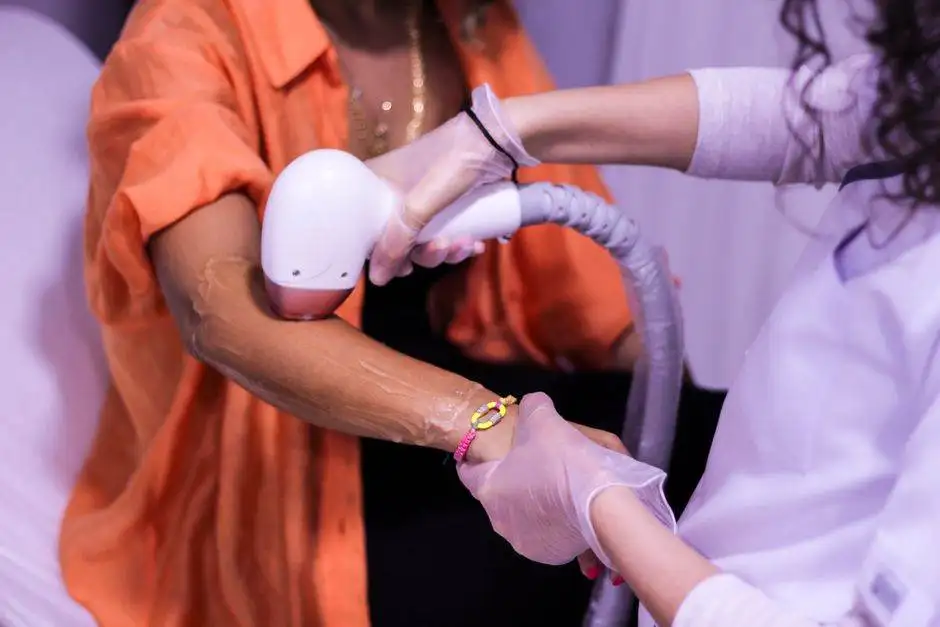
Yes, laser hair removal is possible on dark skin, but it depends on one variable: using a laser whose wavelength and pulse parameters are engineered to bypass epidermal melanin. Without that, the treatment isn't just ineffective—it's dangerous. The device that makes this feasible is the long-pulsed Nd:YAG (1064 nm), which exploits a steep drop in melanin absorption at longer wavelengths to deliver energy to the follicle while leaving the skin's surface largely untouched. This article examines the physics that makes Nd:YAG safe for Fitzpatrick IV–VI, why pulse duration and spot size are not negotiable add-ons, and how to identify a provider who understands the difference between marketing a "dark skin safe" laser and actually operating one within narrow safety margins.
The Myth That Won't Die: Dark Skin and Laser Risks
The belief that dark skin can't have laser hair removal originated from a real problem. The first-generation lasers—ruby at 694 nm and alexandrite at 755 nm—were designed for the high contrast of light skin and dark hair. They exploited melanin as the chromophore, but the melanin in the epidermis competed with the melanin in the follicle. On darker skin, the surface layer absorbed so much energy that it sustained thermal burns, leading to blistering, crusting, and long-lasting pigment irregularity.
Even the diode laser at 810 nm, which offered some improvement, still risked surface damage if used without deep understanding of fluence and pulse modulation. Many clinics never moved beyond these older systems, and many technicians were taught that skin of color was simply contraindicated—not because the biology forbade it, but because their equipment set a hard boundary they didn't know how to cross.
The Physics That Makes Nd:YAG Different
The principle of selective photothermolysis dictates that you need a wavelength preferentially absorbed by the target (hair follicle melanin) with minimal absorption by competing chromophores (epidermal melanin). Melanin's absorption coefficient as a function of wavelength follows a curve that drops significantly beyond 1000 nm. At 1064 nm, melanin absorption is roughly an order of magnitude lower than at 755 nm.
The result? The Nd:YAG beam passes through the epidermis almost unattenuated and then interacts with the deeper, larger melanin structures in the hair bulb and bulge. It's not that the skin is "thicker" or "more resistant"; it's that the light's interaction probability with surface pigment is statistically low. This is a purely physical effect, not a biological adaptation—it works the same for everyone with melanin-rich epidermis, regardless of background.
Why Pulse Duration and Spot Size Matter as Much as Wavelength
A better wavelength solves one problem; pulse duration solves another. Short pulses—the kind used in Q-switched lasers for tattoo removal—deposit energy so quickly that epidermal melanin can't dissipate heat, leading to micro-explosions within the pigment. Long-pulsed Nd:YAG systems (10–30 ms) heat the follicle gradually, giving the epidermis time to shed heat through conduction and active cooling. This thermal relaxation time is what allows the follicle to reach destruction temperature while the surface stays below the injury threshold.
Spot size, too, is not a cosmetic preference. A larger spot (≥10 mm) increases the depth of effective penetration and reduces back-scattering near the surface. A provider who uses a 3 mm spot on dark skin is concentrating energy in a tiny column of tissue, raising the risk of focal burns, even at moderate fluence. The three variables—wavelength, pulse width, spot size—are interdependent; change one without adjusting the others, and the safety window closes.
How Cooling Systems Protect the Epidermis
Cooling isn't a comfort feature. It's a safety mechanism that artificially lowers the baseline skin temperature before the laser pulse arrives, effectively raising the threshold for thermal damage. Contact cooling via a sapphire chill tip, cryogen spray timed a few milliseconds before the pulse, or a continuous stream of cold air all reduce epidermal temperature by varying degrees.
On skin types V and VI, where melanin acts as a heat sink even at 1064 nm, cooling can mean the difference between a mild erythema and a blister. The most reliable systems tie cooling to fluence delivery in a closed loop, so if the skin gets too warm, the device throttles output. Clinics that claim dark-skin expertise but lack active cooling are operating with a critical safety feature missing.
What a Safe Treatment Looks Like Step by Step
A protocol for darker skin should begin with a test patch on a small, hidden area and a 15-minute observation window to check for immediate whealing, perifollicular erythema, or pigment darkening. Based on that response, the operator selects a conservative starting fluence—often 20–30 J/cm² depending on hair thickness and skin depth—that will be escalated over subsequent sessions.
The actual sweep covers the area in a grid pattern, using a chilled gel or direct skin contact. The Nd:YAG pulse feels more like a deep, diffuse ache than the sharp snap of an alexandrite, because surface nerves aren't as activated. Sessions are spaced 4–8 weeks, and 6–8 sessions typically cover the hair cycle's anagen phases. The caveat: hair must still contain enough melanin. White, grey, and very light blonde hairs—regardless of skin color—lack a chromophore for the laser to target.
Risks That Still Apply and How Clinics Minimize Them
Even with optimal parameters, dark skin isn't immune to side effects. Post-inflammatory hyperpigmentation (PIH) is the most common, often triggered by subclinical inflammation from overly aggressive settings or from UV exposure post-treatment. Hypopigmentation—loss of pigment—can occur if melanocytes are reversibly stunned by heat, though this usually resolves over months. Blistering and scarring are severe outcomes that track back almost exclusively to operator error.
Competent clinics reduce these risks by: enforcing a 4-week no-sun window (and often a pre-treatment tyrosinase inhibitor like hydroquinone or azelaic acid for those prone to PIH); titrating fluence up in small increments only after confirming no adverse reaction from the previous session; and never shaving the test spot — allowing them to see perifollicular changes clearly. They also refuse to treat skin that has been sunburned or is showing active inflammation.
Finding a Provider Skilled with Fitzpatrick IV–VI
The device is the first filter: ask directly if the clinic uses an Nd:YAG laser (1064 nm), and confirm it's a medical-grade unit with adjustable pulse duration, not a cosmetic diode hastily marketed for all skin types. Second, press for demonstrable experience. A board-certified dermatologist or a laser technician working under direct physician supervision should be able to show a portfolio of before-and-after images on skin tones comparable to yours.
During consultation, ask operational questions: “What's your starting fluence for a Fitzpatrick VI client with thick, terminal hair?” “How do you modify parameters if the test spot shows immediate perifollicular erythema?” An answer that references a rigid protocol or a one-setting-fits-all approach signals a lack of the adaptive judgment required for safe treatment. Also verify eyewear is rated for 1064 nm; Nd:YAG invisible radiation demands specific protection.
Aftercare for Melanin-Rich Skin
Immediately post-treatment, the area may be red and slightly swollen. Anything that raises skin temperature—exercise, hot water, sauna—should be avoided for 48 hours to prevent amplifying the inflammatory cascade. Apply a plain, fragrance-free emollient like white petrolatum or aloe vera.
Hair shedding typically starts around day 5–7; some mild follicular prominence is normal. Don't wax, pluck, or use chemical depilatories between sessions. Gentle manual exfoliation with a washcloth can help clear shed hairs after the first week. Sun protection is the single most important long-term step: a broad-spectrum SPF 30+ mineral sunscreen (zinc oxide, titanium dioxide) every day, re-applied if outdoors, because melanocytes in dark skin are highly reactive to UV and will deposit pigment at any hint of inflammation.
FAQ
Is Nd:YAG laser completely safe for all dark skin tones?
Safety isn't absolute. Nd:YAG significantly lowers risk compared to shorter wavelengths, but outcomes depend on precise parameter selection and skin condition. When correctly calibrated, permanent pigment alteration is uncommon.
Can laser hair removal cause permanent scarring on dark skin?
Permanent scarring is rare and nearly always iatrogenic—caused by excessive fluence or treating skin that was recently irradiated by the sun. A responsible test-spot protocol catches susceptibility early.
How many sessions do I need?
Expect 6–8 sessions 4–8 weeks apart. Follicles cycle asynchronously, and only follicles in anagen are maximally susceptible; no number of sessions can change that underlying biology.
Does it hurt more on dark skin?
Pain is subjective, but Nd:YAG often feels less sharp than alexandrite because less surface energy deposition reduces tactile nerve activation. Nevertheless, some clients report a deep heating sensation.
Can I use at-home IPL or laser devices on dark skin?
Most at-home IPL and diode devices operate at shorter wavelengths and lower powers without active cooling, making them unsuitable for Fitzpatrick V–VI. Several major manufacturers explicitly warn against it; ignoring that warning can result in burns and patchy hyperpigmentation.
Key Takeaways
- Dark skin is not a contraindication for laser hair removal; the right technology—Nd:YAG at 1064 nm—bypasses epidermal melanin via physics, not wishful thinking.
- Three parameters must be controlled simultaneously: wavelength, pulse duration (long enough for thermal relaxation), and spot size (large enough for deep penetration).
- Active skin cooling is a mandatory safety layer, not an option. Without it, the margin for error narrows sharply.
- The myth persists because many clinics never adopted Nd:YAG or trained staff in the adaptive protocols dark skin requires.
- Provider selection is at least as critical as the laser: test spots, documented experience, and a willingness to adjust settings per session separate safe practitioners from risky ones.
Conclusion
The only real barrier to laser hair removal on dark skin is the absence of the right device in the right hands. When an Nd:YAG system delivers 1064 nm light through controlled pulse durations, large spot sizes, and active cooling, the physics works regardless of Fitzpatrick type. Your next practical step is to locate a provider who can demonstrate that precise combination and who performs a test patch as standard practice. That single in-person assessment will reveal more about safety than any specification sheet.