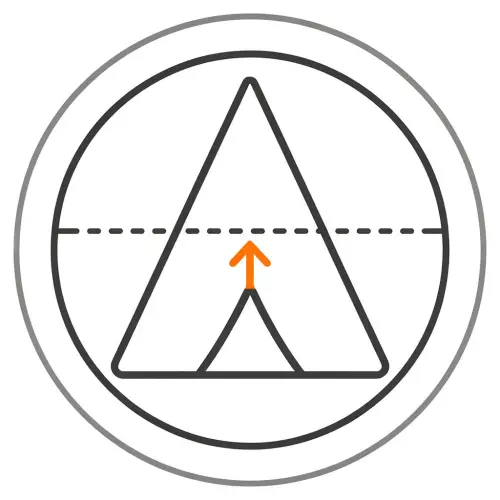
Hydrostatic head is the height of a water column a fabric can hold back before water pushes through it, expressed in millimeters and measured under a standard such as ISO 811, where a swatch is clamped into a cell, water pressure is raised from below at a fixed rate, and the pressure is recorded at the moment water appears on the other side. The number describes exactly one thing: how much standing pressure the material itself resists. As a rough tier system, 1,500 to 5,000 mm is water-resistant and handles drizzle and short showers, while 10,000 mm and above is what the industry sells as waterproof for sustained rain. To decide whether a jacket is right for your conditions, read that number first and then spend far more of your attention on the seams, the zippers, and the condition of the DWR, because on a real hike those are what let water in.
Start by turning millimeters into something you can picture
I do this every time the number goes flat on a spec sheet, which is most of the time. Ten thousand millimeters is thirty-three feet. A 20,000 mm fabric is holding back a column of water sixty-five feet tall. A 5,000 mm shell marketed as water-resistant is holding back sixteen feet.
Now picture your last wet hike. Nothing stacked thirty-three feet of water on your shoulders. Rain falls, beads, and runs off. It never gets to build a standing column, which is why people come home dry in modest shells and soaked in expensive ones. The rating is a ceiling on one specific kind of pressure, and rain alone rarely gets you to that ceiling.
You get there from other directions.
Set the test up in your own kitchen and the mechanic becomes obvious. Cut the top off a two-liter bottle, stretch a scrap of jacket fabric over the opening, hold it down with a rubber band, and pour water in. From the side you can watch the cloth dome slightly under the weight. Then a bead forms on the underside. Then a second. Then water is through, and the height of the column above it is the number on the tag. The whole thing is quiet and dull and takes about a minute. The dullness is the point: flat fabric, still water, no seams, no flexing, no abrasion, no pack strap, no sun, no dirt, no five seasons of being crammed into a stuff sack. A lab test isolates one variable so it can be compared. A jacket in weather is the opposite of one variable.
Two details in that rig explain why numbers from different brands don't compare cleanly. The pressure has to rise at a defined rate, and the common ones sit in the neighborhood of 60 cm of water per minute. Change the rate and you change the reading, because some fabrics will wet through under a slow rise that they'd resist under a fast one. And methods disagree about when the test ends. ISO 811, the one you'll see cited most, records the pressure at the third drop of water showing through. Some other methods stop at the first sign. A first-drop figure and a third-drop figure for the same fabric will not match, and neither one is a lie. So when you see 10,000 mm and 15,000 mm on two hangtags, the honest read is "both of these are in the waterproof tier," not "one is fifty percent better."
Where the fabric number stops mattering
Follow the water. That is the entire method. Water enters a jacket through the fabric, through the seams, through zippers and pockets and cuffs, or it never enters at all and condenses on the inside instead. The fabric is the route that fails least often, which is a strange thing to realize about the number everyone argues over.
Seams come first. Every stitched seam is a row of needle holes punched straight through the laminate, and a needle hole is a tube. An untaped seam will pass water whether the fabric behind it says 5,000 mm or 30,000 mm, because the fabric isn't the leak. The stitching is. In practice, moving from a 10,000 mm jacket with fully taped seams to a 20,000 mm jacket with the same construction buys you less dry time than simply choosing a lower-tier jacket with the same fabric that's fully taped. When I have two of them in my hands, the question I ask isn't how high the number goes. It's where the tape is. The zones that decide it are the shoulders, the hood, the chest, and the tops of the arms, anywhere water can land or pool.
Zippers are the second gap. A zipper is a row of teeth with a channel down the middle of it, whatever the pull tab claims. What keeps water out is the storm flap in front of it, the quality of that flap, and whether the zipper itself is a coated, water-resistant type. A jacket can carry an excellent hydrostatic head and a mediocre main zipper and let water in at the chest all afternoon.
The failure nobody prints on the hangtag
Hydrostatic head says nothing about breathability. Those are separate measurements, and the thing keeping rain out has nothing to do with whether vapor can get out. A jacket with a 20,000 mm rating, a dead DWR, and a saturated face fabric produces the classic result: dry from the rain, soaked from the inside. On a long climb that's worse than being rained on, because now your insulation is wet and the weather isn't clearing.
Telling the two apart on the trail is a skill worth having. Condensation is broad and diffuse, a clammy mist across the back and chest, damp inside the sleeves, no obvious line to it. A leak is localized and directional: a wet stripe running down from a seam, a cold patch directly under the shoulder strap, a damp spot behind the pocket. Feel the inside of the hood and the middle of your back before you blame the fabric.
The DWR is what keeps the face fabric from saturating, and the face fabric saturating is what shuts the membrane down. When the outer cloth wets out, goes dark, stops beading, hangs heavy and cold, vapor movement collapses and the jacket starts to feel like a plastic bag. The membrane is still holding water out. The system has stopped working. That is not a hydrostatic head problem. It's a maintenance problem, and it responds to a wash and a low dryer cycle more often than people expect.
Pressure points, which is where the number gets real
There is a legitimate reason the static column test exists. On your body, the fabric isn't always a flat swatch with nothing pressing on it. Run the arithmetic roughly. A twenty-pound pack load carried on a strap footprint of a few square inches works out to pressure equivalent to a column of water on the order of a meter high, and that's before the load concentrates at the edges of the strap, which is where the fabric actually gets pinched. Sit down on wet ground and the pressure under you is higher. Kneel in wet grass and you're asking a piece of cloth to hold back feet of water at a point, through a crease, with grit in it.
That's the honest case for a higher rating. Not rainfall, but load. If your jacket lives under a pack, or you sit and kneel in it, you want margin above the minimum. Past a certain point, somewhere around 20,000 mm, you're buying margin you can't feel, and that effort is better spent on seam construction. Below that point, every step up adds real protection at the spots where your own body pressure pushes water through the cloth.
Abrasion and dirt work along the same axis. Fine grit ground into a shoulder panel scuffs the coating. Oils from skin and sunscreen lower the surface tension of the water sitting on the fabric and help it creep through where it wouldn't otherwise. A jacket that tested at 20,000 mm when it was new is not a 20,000 mm jacket at the shoulders after three seasons. Coatings age, seam tape lifts at the corners, and laminated layers delaminate, which you'll see as bubbles or a wrinkled inner surface peeling away. That's the end of the jacket's waterproof life no matter what the tag said the day you bought it.
Reading a spec sheet like a skeptic
When you're looking at the numbers, ask in this order:
- Is the figure for the fabric alone, or for the assembled garment? Fabric numbers are the ones you'll almost always get, and they ignore every seam on the jacket.
- Which standard, and which endpoint? ISO 811 is the common citation in the U.S. market, with AATCC 127 close behind. If you can't tell whether the figure is first-drop or third-drop, treat it as a tier, not a value.
- Are the seams taped, and are all of them taped? Critically taped, meaning shoulders and hood, is far better than untaped. Fully taped is better still.
- Is there a DWR, and is it durable or a factory spray that will wash out in a month?
- Does the main zipper have a storm flap, and are the pocket zippers covered?
None of that requires a lab.
Matching the number to the trip
For a day hike in summer showers, a water-resistant shell in the 5,000 mm range with taped seams does the job, and it usually breathes better because it's a lighter fabric. For a multi-day trip where it rains for two days straight, the kind of shoulder-season weather that never quite dries out, 10,000 to 20,000 mm with fully taped seams and a three-layer construction is the range where you stop thinking about the jacket at all. If you're carrying a heavy pack in sustained rain, strap pressure is the deciding factor, and it argues for the top of that range and taped shoulders specifically.
Above roughly 20,000 mm the differences flatten out. What separates two jackets up there is seams, fit, hood design, ventilation, and whether you keep the DWR alive. The number has already done its job by 10,000 mm. Everything above that is insurance against pressure you probably won't apply unless you're kneeling, sitting, or hauling.
The five-minute job that stretches the rating
Wash the jacket. Not often, but whenever the face fabric stops beading. Use a technical wash or a mild detergent with no softener and no bleach, and run a second rinse cycle if you're unsure how much residue is left. Then dry it on low or medium heat. Heat reactivates most factory DWR finishes, and the heat is doing more of the work than any additive. If beading still doesn't return, apply a DWR made for waterproof-breathable fabric, and choose the spray-on type if breathability matters to you, because wash-in treatments coat the inside of the garment along with the outside.
Store it loosely rather than compressed, dry, and out of a hot car. Heat and time are what kill coatings. Re-tape peeling seams if you're willing, or accept the leak and demote the jacket to dry days.
The thing I wish I'd understood years ago is that hydrostatic head is a specification for a material, not a promise about a garment. Read it as the fabric's ceiling, and then go find out where water actually gets in. It is almost never the place the millimeter number lives.