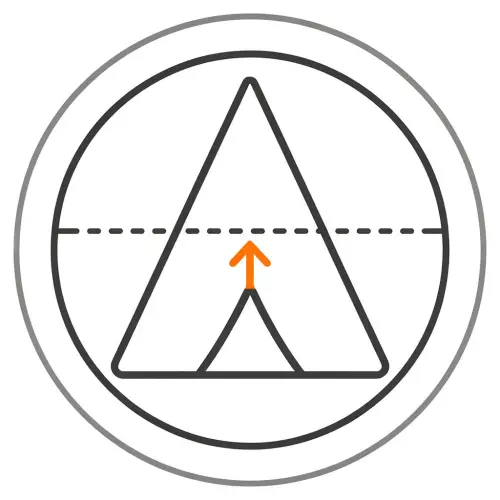
Denier and hydrostatic head measure two different things, and only one of them answers whether a fabric will keep water out. Denier is a yarn weight, which makes it a thickness and abrasion number. Hydrostatic head is the waterproofing number, reported in millimeters of water column, and it is the one you read when the question is whether you stay dry. The two belong side by side on a spec sheet. They never stand in for each other.
The night I stopped trusting the big number on the tag
I was lying on my side in a tent on the third night of a wet stretch, and the foot of my sleeping bag had gone cold and slick.
Not soaked. Cold. That slow, clammy cold you get when water is moving through a fabric a drop at a time instead of all at once. I put my palm flat against the inside of the fly. The fabric was intact. No tear, no pinhole I could find, nothing I had done to it. Water was simply coming through the wall.
I had bought that tent on the strength of one number. It was printed large on the hang tag and repeated in the description: a heavy denier. Tough fabric, the thinking went, so obviously dry fabric. I had read the smaller line underneath, something with four digits and "mm" after it, and moved on like it was fine print.
At home I draped the fly over the back fence and put a headlamp behind it, which is the fastest way I know to find a leak's address. Where the wet spot had been, the coating looked fine. Just above it, along a seam, a thin grey line of dried sealant was lifting at one edge. A hairline failure. My own handiwork from a couple of seasons back.
The denier had done exactly what denier does. It kept the fabric from ripping. It had nothing to do with the water.
What hydrostatic head is actually measuring
The test is simple to describe. A swatch of fabric gets clamped over a ring, water sits on top of it in a column, and the pressure is raised until droplets show up on the underside. The height of that column when the third drop appears is the hydrostatic head, and it gets written down in millimeters. ISO 811 and AATCC 127 are the two test methods you'll see cited for it.
That's why the number reads like altitude instead of a rating. Three thousand millimeters isn't a score out of anything. It's a physical height of water the fabric held back before it started weeping.
Two things about that number matter more than people expect.
First, the scale is not intuitive. Under roughly a thousand millimeters, most manufacturers won't use the word waterproof at all. Around fifteen hundred millimeters is the working floor for the label. Real three-season tent flies commonly sit in the low thousands, and floors and pack fabrics run much higher because they take load. The exact cutoffs vary by maker, but the shape of the scale is consistent, and once you've seen a few hundred hang tags you can read it at a glance.
Second, and this is the part that cost me a cold night: that number describes fabric. It does not describe a tent. The sample in the test rig is a flat, new, unstressed square. Your fly is a sewn object with seams, a zipper, a coating that has been folded into a stuff sack a hundred times, and a boundary where it meets the ground. None of that is in the millimeter figure.
Why a 20D fly can out-hold a 100D one
Denier is the weight in grams of nine thousand meters of a given yarn. That's the whole definition. A 20D yarn is fine and light; a 100D yarn is coarse and heavy. It tells you about the thread, not about the sheet.
So a 20-denier face fabric with a well-applied coating can post a higher hydrostatic head than a 100-denier fabric with no coating at all, and it isn't even close. Uncoated nylon is a strong, thirsty sheet. It will wet out and pass water and there is no reading on the tag that fixes that, because the coating is doing the work and the yarn never was.
Fine yarns do have one quiet advantage: for the same fabric weight, finer filaments mean more threads per inch, which gives a tighter, smoother surface for a coating to sit on. Coarse yarns give you a rougher weave and more room between threads. That's a generalization, not a law, because weave pattern and thread count move independently of denier, and a coated 100D plain weave behaves differently from a 100D ripstop. But it's the right direction of thinking. The coating is the rain barrier. The yarn is the frame it hangs on.
Where the coating type changes the rules
If you take one thing from this, take this one: for leaks, the coating chemistry matters more than the face denier.
Polyurethane coatings bond well enough that a factory can heat-tape the seams for you. That's a real convenience, and it's why so many mainstream tents come out of the box with taped seams and a solid millimeter rating. The tradeoff is that PU is the less stable of the two common coatings. Store a PU-coated item damp for a season and you may come back to a tacky, gummy surface and coating that peels away from the fabric in sheets. I've opened a stuff sack after two summers and found exactly that. The millimeter rating on the tag was still printed there. The coating that earned it was gone.
Silicone coatings, usually on nylon and commonly called silnylon, sit at the other end. They tend to deliver more water resistance per gram, they don't hydrolyze the way PU does, and they hold up to UV better. What they don't do is accept tape. Silicone is slippery enough that adhesive seam tape won't stick to it, so those seams get sealed with a silicone sealant instead, either at the factory or by you at the kitchen table before your first trip. That's a step people miss because the spec sheet mentions the coating and the millimeter rating and says nothing about the tube of sealant you're going to need.
Silicone has a second quirk worth knowing. It stretches when it gets wet, so a silnylon fly will sag overnight in real rain and need re-tensioning. That's not a defect. It's the material behaving the way it behaves.
Neither coating is better in the abstract. They fail differently. PU fails on the shelf and at the seam tape. Silicone fails at the seam you sealed yourself, and it's harder to patch in the field because ordinary adhesive patches don't grab it.
Denier still answers a real question, just not this one
I don't want to leave the impression that denier is marketing noise. It isn't. It's the number that tells you how long the waterproofing gets to last.
Waterproofness and durability are two budgets, and you spend them separately. A 10-denier floor fabric is not unwaterproof. It's waterproof right up until you kneel on it on a granite slab, or slide a loaded pack across it, or drag it over sand for a week. Once the fibers abrade thin, the coating goes with them, and pressure finds the thin spot. A 70-denier floor takes that same abuse and keeps its coating intact, which means it keeps the hydrostatic head it was sold with.
The same logic applies to the rating itself. Hydrostatic head is measured on new fabric, before abrasion and before UV exposure. A three-thousand-millimeter fly that has spent two summers pitched in the sun is not a three-thousand-millimeter fly anymore, even though nothing on the tag changed. Denier is your best guess at how slowly that number decays under the way you actually use the thing.
So read it. Read it as an abrasion and puncture number, and use it to decide whether you're looking at a floor you can kneel on or a fly that will survive a windy ridgeline. Just don't read it as a rain number.
The specs that don't make it onto the hang tag
Seams are where most tents leak, and every one of them is a break in the fabric's rating. A seam that's taped, a seam that's sealed, and a seam that's neither can come off the same production line with the same millimeter number printed on the same tag.
The floor-to-wall junction, the zipper flap, and the point where the fly meets the ground are all weak links the test rig never saw. And breathability is an entirely separate axis from waterproofing. A fabric can hold back an enormous column of water and still turn into a condensation chamber overnight, because hydrostatic head and moisture vapor transmission are two different measurements answering two different questions. High water resistance with low breathability is a damp sleeping bag for a different reason than a leak.
When I'm holding two tents in a shop now, I read in this order. Hydrostatic head first, because that's the rain question. Then the coating type, because that tells me how the seams are handled and how the thing will age in my closet. Then denier, to decide how much abuse it survives before the first two numbers stop meaning anything. Three numbers, three questions. Getting them in the right order is most of the work.