The hang is almost always lower than the person who tied it believes. A plain toss over a limb leaves you with a pulley, not a lock — the line feeds straight back down the moment anything pulls on the bag — and the rope, the limb, and the settling load each hand back a little more height after you walk away. The PCT method closes that gap with three pieces: one line, one carabiner, and one stick tied onto the free end so the carabiner cannot descend past it. Choose a live, sound limb at least 15 feet up and 10 feet out from the trunk, run the sequence in order, and then haul down on the finished hang with your full weight while there is still light to fix whatever moves.
I want you standing at the base of the tree with me, in the last twenty minutes of usable light, because that is when this decision actually gets made. The bag is already clipped on. The line is over the limb. Your shoulders are tired, the stove is still warm, and everything in front of you looks fine. It looked fine the morning I found a chewed strap and a food bag sitting on the duff, too. That morning is why I stopped treating the knot as the hard part and started treating the tree as the hard part.
So stop looking up at the bag. Look at what's holding it.
A toss over a limb is not a lock
Hang a bag the simple way — line over the branch, one end on the bag, the other tied to the trunk — and the tie-off feels like the security. It isn't. The knot isn't what fails; the geometry is. The line is slick, the limb is smooth, and the entire load hangs on one side. Anything that gets a paw on the bag and pulls down wins the tug-of-war: line feeds over the limb, the bag comes down, and your knot is still sitting where you left it, holding nothing. I watched a raccoon beat one of these in under a minute, on a limb I'd have sworn was too small for anything bigger than a squirrel.
The counterbalance hang, with a bag on each side of the limb, is a real improvement, but the only thing holding it is friction against bark that may be wet or mossy, and it leaves the lower bag within reach of something standing on the ground. On a limb that sags, the two sides are in a slow contest, and one of them always ends up lower than you planned.
The PCT method takes the contest out of it. The bag can't be pulled down because a physical stop blocks the descent. Friction can fail; a jam can't.
Picking the limb is most of the job
Everything after this is mechanics. The limb decides whether the hang is worth anything.
You want a live limb, at least 15 feet above the ground where your line will cross it, extending at least 10 feet horizontally from the trunk so the crossing point sits well away from the tree. Those two numbers are the floor, not the target. The distance from the trunk is what keeps the bag 5 feet or more clear of the tree, so nothing can brace against the trunk while it works on your bag. The height is what keeps the bag out of reach.
Then there's the part nobody checks, because it's above the beam of a headlamp: what's directly above and directly below the crossing point. A limb 4 feet above your bag is a walkway — a bear can climb the trunk, walk out that limb, and drop onto your food. A stout limb 3 feet below your bag is a step. You want the bag hanging in a vertical window with nothing climbable above it and nothing to stand on beneath it.
Ground matters too. A hummock, a root ball, or a slope under the tree steals height you already paid for. Hanging over the lowest ground available in that spot is free vertical clearance.
Judging height and soundness from the ground
Two habits fix most of this.
The first is marking your throw line before the trip. Lay the line out at home, measure it, and put a permanent marker dot at 10, 15, and 20 feet. You now have a ruler that goes over the limb with you. That beats squinting up a trunk from directly beneath it, where foreshortening makes every limb look higher than it is. Step back 20 feet and look at the tree from the side, too — the crossing point is easier to judge against the horizon or a neighboring tree than against open sky.
If you'd rather not mark the line, use your own reach. Standing with one hand overhead, most adults span their own height plus about a foot and a half. Two of those stacked is roughly 15 feet. If the line crosses the limb at less than two of your reach units above your feet, it isn't high enough, no matter how it looks from below.
The second habit is testing the limb before the bag goes up. Get the line over it, grab both ends, and hang your weight on it. A limb that dips sharply, creaks, or visibly bows is not a limb that holds 20 pounds of food every night. Watch for a bare, clean tip with no fine twigs — that's often dead wood still attached to a live tree, and dead wood is the failure you can't see coming. Look at the bark where the limb meets the trunk, too; sloughing or a visible crack is a no.
Hardwood over softwood is a decent rule, but broadleaf doesn't automatically mean strong. Aspen and cottonwood are broadleaf and famously brittle, and they shed limbs in wind. Conifers are often the only tall trees around and often the worst choice, since the low whorls are full of dead branches. Oak, hickory, maple, and beech are the reliable ones across most of the eastern and central U.S. Out west you take what the site gives you, and a substantial live pine or fir limb will do — but only if it passes the weight test.
Running the sequence in order
The order is the method. Skip a step and you've built the ordinary hang with extra gear.
- Get the line over the limb. Throw past the limb, not at it, then draw it back so it settles over the wood.
- Attach the carabiner to one end of the line — a figure-eight loop clipped in, or the line tied directly to the carabiner's eye.
- Clip the carabiner to the bag's hang loop or top strap.
- Take the free end and pull the bag all the way up to the limb. Pull from off to one side of the trunk, not from directly beneath a loaded bag.
- Keep the free end taut and tie the stick onto it at the highest point you can reach comfortably — a clove hitch or five tight wraps, finished so it can't work loose. If your feet are on flat ground, get up on a rock or a log for these thirty seconds; that height pays off later.
- Let the free end out slowly. The bag descends, the free end climbs, and you'll hear a small tick when the stick meets the carabiner. That tick is the lock setting.
- Leave the tail below the stick hanging. It's the handle you're offering to anything that wanders by, and pulling down on it does nothing useful: it feeds more line up over the limb, which raises the bag.
Line length stops being an afterthought once you run the numbers. The line has to reach from the carabiner, up over the limb, back down to your reach height, plus a few feet of tail. For a 20-foot limb, a 50-foot line is the right order of magnitude, not a 25-footer. A line that's too short means the bag goes up and the stick has nowhere to be tied.
Why the bag stops lower than the limb
This is the part that took me an embarrassingly long time to work out, and it's the reason a hang you were proud of at dusk looks thin in the morning.
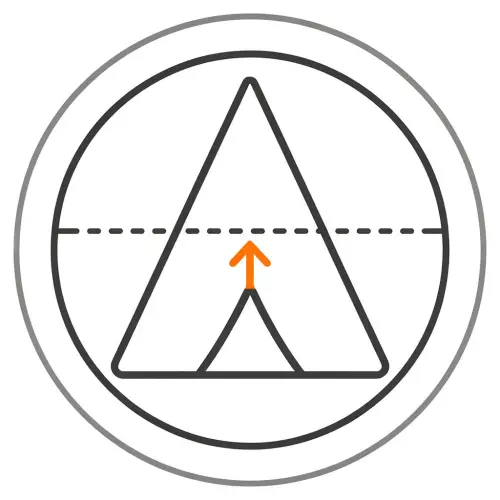
When the bag is up at the limb and you tie the stick at your reach height, the stick and the carabiner start out separated by the distance between your hands and the limb. Then both move. The carabiner descends with the bag; the stick rises with the line. They close that gap from both ends, so they meet when each has covered half of it. The bag settles at roughly the average of the limb height and the height where you tied the stick.
Run it: an 18-foot limb with the stick tied at 6 feet parks the bag near 12 feet. A 20-foot limb and a 7-foot tie gets you close to 13 and a half. That's why the PCT method reads as a twelve-foot hang most of the time — the geometry lands there whether you planned it or not.
It also tells you where the leverage is. The 15-foot rule is about the limb, and a 15-foot limb with a chest-high tie puts the bag at about 10 and a half feet — barely over the 10-foot minimum, with no margin at all. You have two ways to push it up: a higher limb, and a stick tied higher. If your reach is the limit, find higher ground to stand on while you tie, or find a better tree. Don't compromise on the limb and hope the stick makes up for it.
And then let it settle. Lines creep after the load goes on. A stretchy cord — thin nylon paracord is the usual culprit — keeps giving for the first hour or so, and a limb that flexed under the bag relaxes as the wood takes the load. Check the hang a few minutes after you walk away and again before you sleep. If the tail has crept, the lock is still working; the whole assembly has just sagged a few inches, and you want to know that.
Test it before the light goes
None of this counts until you load it the way something with claws would.
With the stick jammed against the carabiner, grab the bag or the line just above it and pull down as hard as you can with your whole body weight. Watch the stick while you pull, not the bag. If the stick slides, rotates off the carabiner, or the bag drops even a couple of inches, the jam isn't a jam — redo it. Then grab the tail below the stick and pull it down hard. The bag shouldn't move at all. If pulling the tail lowers the bag, the stick ended up on the wrong side of the carabiner, or you tied it before the carabiner was where you thought it was.
Do that test while you can still see both the stick and the crossing point. That's the real reason food goes up before dark. After dark you can't judge the limb, you can't see whether the line crosses where you aimed, you can't see the stick seat, and a failed test means repeating the whole throw by headlamp. Cook and eat first if you like, then hang while there's still light — that window is the whole evening. Keep the tree away from both the kitchen and the sleeping area, so nothing that follows the smell wanders through where you're lying.
One honest limit: no hang is bear-proof. A bear that has learned what a hanging bag is can usually find a way, and the PCT method buys time and protects food from the smaller and more common raiders rather than making you invisible. And if the site has no suitable tree — no live limb at the right height and reach, or nothing but brittle aspen and dead conifer whorls — this isn't a rope problem, and a longer line won't solve it.